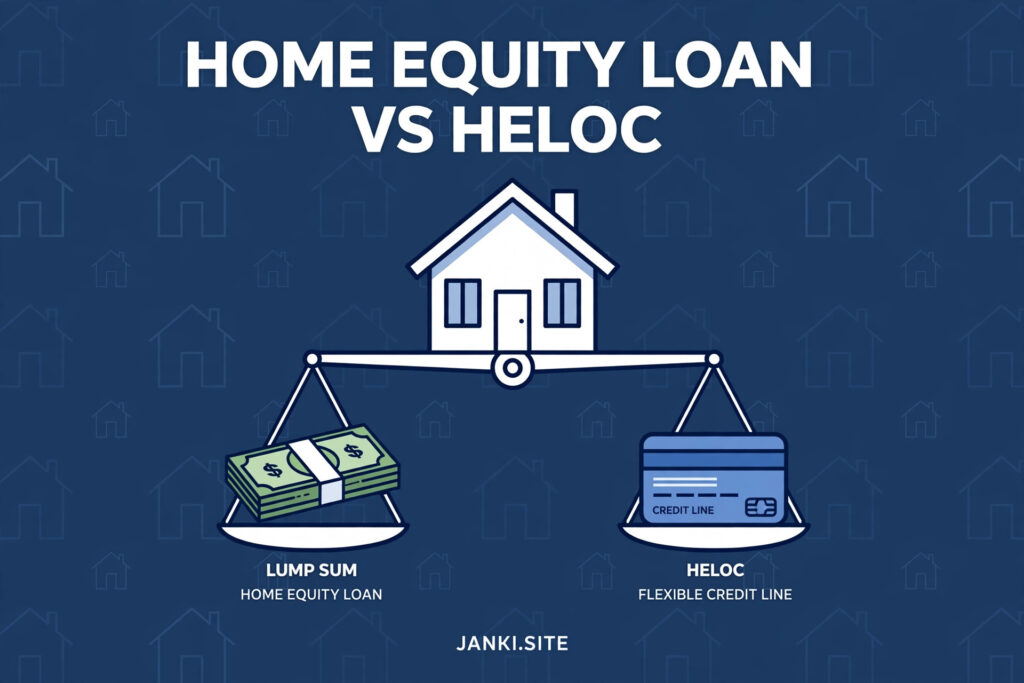
If you have built up equity in your home — the difference between what your home is worth and what you still owe on your mortgage — you can borrow against it in two main ways: a home equity loan or a home equity line of credit (HELOC). They sound similar and both use your house as collateral, but they hand you the money, charge interest, and expect repayment in very different ways. Choosing the wrong one can mean unpredictable payments or paying interest on money you did not need yet.
Here is how each works, a side-by-side comparison, how much you can borrow, the costs and risks, and how to decide which fits your situation. (If you are still fuzzy on the basics, our beginner’s guide on how mortgages work covers the foundation.)
What Is a Home Equity Loan?
A home equity loan is a one-time lump sum that you repay in fixed monthly installments over a set term — commonly 5 to 30 years. The interest rate is typically fixed, so your payment never changes. Because it creates a second lien on the property, it is often called a “second mortgage.”
Home equity loans suit one-time, known expenses: a roof replacement with a firm quote, a medical bill, or consolidating a specific pile of high-interest debt. You know exactly how much you need, you receive it once, and you pay it down on a predictable schedule.
What Is a HELOC?
A HELOC works more like a credit card secured by your home. The lender approves a credit limit, and during the draw period — often 10 years — you can borrow, repay, and borrow again as needed. During the draw period, many HELOCs require only interest payments on what you have drawn. After the draw period ends, the repayment period begins (often up to 20 years), during which you repay principal and interest and can no longer draw.
Two features define HELOCs: the rate is usually variable, tied to an index such as the prime rate, so your payment can rise or fall over time; and you pay interest only on the amount you actually use, not the full credit line. That makes a HELOC a good fit for phased or uncertain costs — a renovation done in stages, or a flexible emergency backstop.
Home Equity Loan vs HELOC: Side-by-Side
| Feature | Home Equity Loan | HELOC |
|---|---|---|
| How you get the money | One lump sum | Draw as needed, up to a limit |
| Interest rate | Typically fixed | Typically variable |
| Monthly payment | Same every month | Changes with balance and rate |
| Interest charged on | Full amount from day one | Only what you have drawn |
| Repayment structure | Fixed schedule from the start | Draw period, then repayment period |
| Best for | One-time expense with a known cost | Ongoing or uncertain expenses |
How Much Can You Borrow?
Both products are governed by your combined loan-to-value ratio (CLTV) — your total mortgage debt divided by your home’s value. Many lenders cap CLTV at around 80%, though some go higher for well-qualified borrowers.
Example: your home is worth $400,000 and you owe $240,000 on your first mortgage. At an 80% CLTV cap, your total home debt can reach $320,000 — leaving up to $80,000 available through a home equity loan or HELOC. Lenders will also review your credit score, income, and existing debts, much as they do in the mortgage pre-approval process.
Costs and Fees to Expect
Neither product is free to set up. Home equity loans commonly carry closing costs in the range of roughly 2% to 5% of the loan amount — appraisal, title, and origination fees similar to a first mortgage. HELOCs sometimes advertise lower upfront costs, but read the fine print: you may face annual fees during the draw period, transaction fees, or an early-closure fee if you shut the line within the first few years. Always compare the full fee picture, not just the headline rate.
Is the Interest Tax-Deductible?
Under current IRS rules, interest on home equity borrowing is generally deductible only when the money is used to buy, build, or substantially improve the home that secures the loan. Using the funds for personal expenses — a car, a vacation, everyday spending — does not qualify. Tax rules change and personal situations vary, so confirm your specific case with a tax professional before counting on a deduction.
The Risk Both Products Share
Because both are secured by your home, falling behind can lead to foreclosure — the stakes are fundamentally different from an unsecured credit card or personal loan. This is why using home equity to pay off credit card debt deserves special caution: you convert unsecured debt into debt tied to your house. Our breakdown of debt consolidation loan pros and cons walks through when consolidating helps and when it merely moves the problem. With a HELOC, add one more risk: a variable rate can climb, turning a comfortable interest-only payment into a much larger one when the repayment period starts.
Which One Should You Choose?
Choose a home equity loan if you have a single expense with a firm price, you value a payment that never changes, and you want the discipline of a fixed payoff schedule.
Choose a HELOC if your costs will arrive in stages or are hard to predict, you only want to pay interest on money actually used, and you are comfortable with a variable rate — ideally with a plan to repay draws quickly rather than letting them linger.
Either way, borrow the minimum you truly need, keep an emergency cushion elsewhere, and remember that your home is the collateral.
FAQ
Can I have a home equity loan and a HELOC at the same time?
Possibly, if your CLTV stays within the lender’s cap and you qualify on income and credit — but two liens plus your first mortgage stack up fixed obligations fast. Most borrowers pick one.
How long does approval take?
Both products require an appraisal and income verification, so closing commonly takes several weeks — longer than an unsecured personal loan. Plan ahead rather than treating either as emergency cash.
Does a HELOC hurt my credit score?
Opening one adds an inquiry and a new account, and using a large share of the line can raise your reported utilization. Kept modest and paid on time, it behaves like any other credit account.
Key Takeaways
- Home equity loan: lump sum, fixed rate, predictable payments — best for one-time known costs.
- HELOC: flexible line, usually variable rate, interest only on what you draw — best for staged or uncertain costs.
- Borrowing is capped by CLTV, commonly around 80% of your home’s value across all mortgage debt.
- Both put your home at risk; compare total fees and tax treatment before signing.