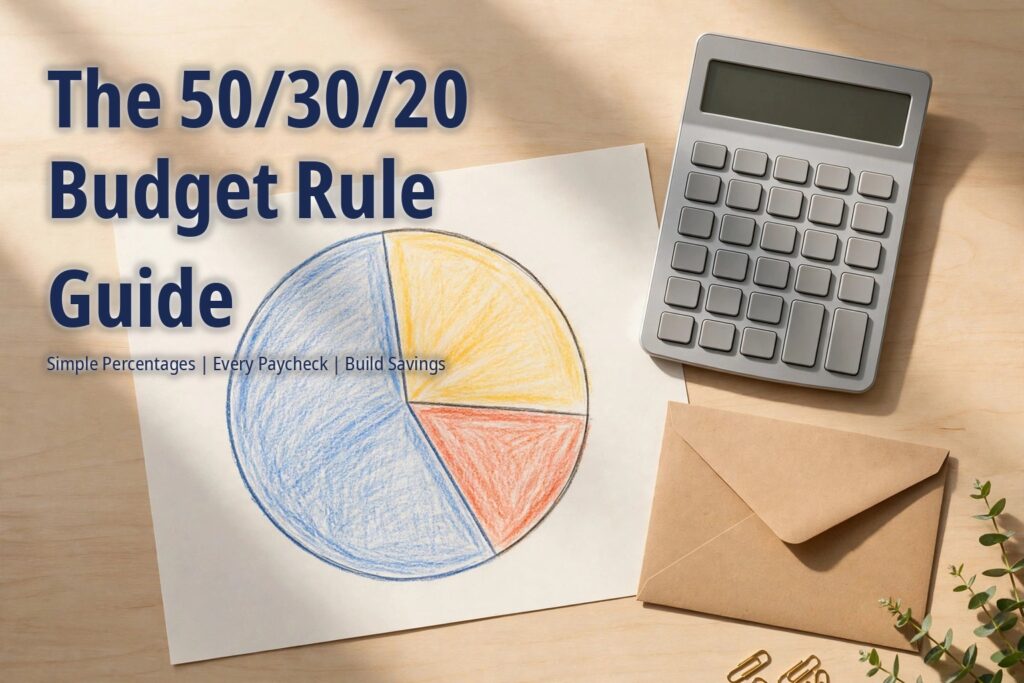
Budgeting advice often drowns you in spreadsheets and guilt. The 50/30/20 budget rule does the opposite: it splits your after-tax income into just three buckets, needs, wants, and savings, so you always know roughly where your money should go without tracking every coffee.
This beginner-friendly guide explains the rule, walks through worked paycheck examples, and shows how to adapt it when your numbers do not fit neatly.
What Is the 50/30/20 Budget Rule?
Popularized by Senator Elizabeth Warren in her book All Your Worth, the rule divides after-tax income like this:
- 50% for needs. Housing, utilities, groceries, transportation, insurance, minimum debt payments, childcare, anything you must pay to live and work.
- 30% for wants. Dining out, streaming services, hobbies, travel, shopping beyond basics. The fun money that makes life enjoyable.
- 20% for savings and extra debt payoff. Emergency fund contributions (see how much emergency fund you need), retirement investing, and payments above minimums on debt. Attacking high-interest balances? The strategies in how to pay off credit card debt fast fit right into this bucket.
Worked Example: A $4,000 Monthly Paycheck
On $4,000 of after-tax monthly income:
- Needs: $2,000. Rent $1,300, utilities $150, groceries $350, car insurance and gas $200.
- Wants: $1,200. Restaurants $300, subscriptions $60, hobbies and shopping $840.
- Savings: $800. $300 to the emergency fund, $300 to a 401(k), $200 extra toward a credit card balance.
Notice the savings bucket working two jobs at once: building a buffer and killing expensive debt. That dual purpose is exactly what makes the 20 percent so powerful.
Worked Example: A $2,600 Monthly Paycheck
Lower income, tighter math:
- Needs: $1,300. Shared rent $800, utilities $100, groceries $250, bus pass $150.
- Wants: $780. This is where discipline matters most at lower incomes.
- Savings: $520. Even $200 a month to savings builds $2,400 a year. Start where you can.
How to Adapt the Rule to Your Situation
The 50/30/20 split is a starting point, not a law. Common adaptations:
- High housing costs? Try 60/20/20 temporarily while you plan a move or a raise. The key is keeping the 20 percent savings intact.
- Aggressive debt payoff? Flip to 50/20/30, shrinking wants to accelerate the debt-free date. Compare payoff orders with debt snowball vs avalanche.
- Irregular income? Apply the percentages to each paycheck as it arrives, and keep a one-month buffer so lean months still cover needs.
- Already debt-free with a full emergency fund? Push savings beyond 20 percent toward investing; the rule becomes a floor, not a ceiling.
Common Mistakes Beginners Make
- Counting wants as needs. A $80 phone plan is a need; the $140 unlimited premium plan is partly a want. Be honest.
- Forgetting irregular bills. Car registration, holiday gifts, and annual subscriptions ambush monthly budgets. Divide them by 12 and “pay” yourself monthly.
- Skipping the savings bucket “just this month.” One skipped month becomes twelve. Automate the transfer on payday.
Frequently Asked Questions
Is the 50/30/20 rule good for beginners?
Yes. It is one of the simplest budgeting frameworks because it uses three broad categories instead of dozens of line items, which makes it far easier to stick with.
Does the 50/30/20 rule use gross or net income?
After-tax (take-home) income. Taxes are not money you can allocate, so base the percentages on what actually lands in your account.
What if my needs are more than 50%?
That is common in high-cost cities. Treat 50 percent as a target: trim wants first, protect the 20 percent savings, and work on the big levers like housing and transportation.
Where should the 20% savings go first?
In order: a $1,000 starter emergency fund, high-interest debt payoff, a full 3 to 6 month emergency fund, then retirement investing.
Conclusion
The 50/30/20 budget rule works because it is simple enough to remember and flexible enough to adapt. Put half your take-home pay toward needs, cap wants at 30 percent, and protect 20 percent for savings and debt payoff. Automate the savings transfer, revisit the split twice a year, and let the system run.